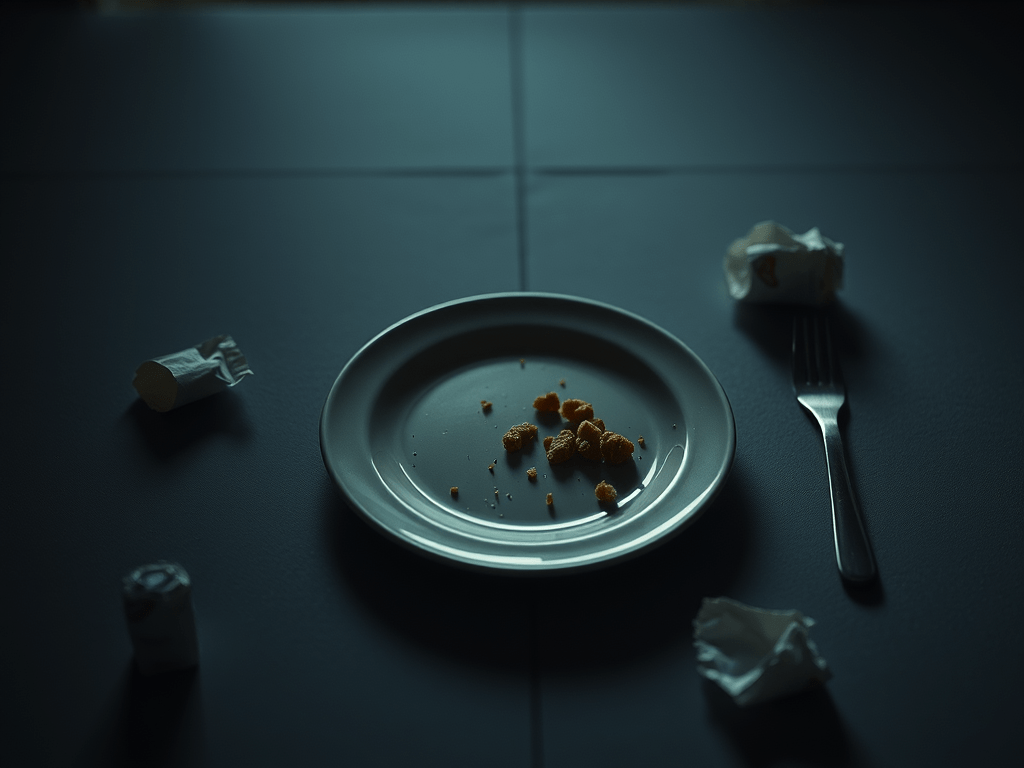
I’ve stared at my plate for 45 minutes now. The food has gone cold. My stomach growls, but the disconnect between hunger and action remains unbridgeable. This is my third attempt at dinner today. My therapist calls it “no motivation to eat” – a clinical term that barely scratches the surface of this daily struggle.
Ten years ago, I was on the opposite end of the spectrum. Food consumed my every thought. I’d plan elaborate binges, hide wrappers, and spend hours on the anorexia nervosa forum seeking validation for my disordered behaviors. The pendulum has swung between restriction and compulsion so many times I’ve lost count.
This is my eating disorder story. It’s messy, non-linear, and still unfolding. If you’re somewhere on this spectrum yourself, maybe something in my journey will resonate with you.
Why Do I Forget to Eat? The Restriction Paradox
People are often surprised when I tell them I regularly forget to eat. “How is that possible?” they ask. “Don’t you get hungry?”
Of course I get hungry. But years of ignoring hunger cues have disconnected my body’s signals from my brain’s response system. It’s like a doorbell that keeps ringing, but nobody inside acknowledges it’s time to answer the door.
During my worst restrictive phases, I’d frequently ask myself “why do I keep forgetting to eat?” as if it were some mystery rather than the direct result of years of disordered eating. My dietitian finally explained it wasn’t forgetfulness at all – it was my eating disorder masquerading as absentmindedness.
The forgetting had become a convenient fiction. If I “forgot” to eat, I didn’t have to admit I was actively choosing restriction. It was the perfect cover story, even to myself.
The physical consequences piled up. Constant dizziness. Hair loss. Brittle nails. Irregular heartbeat. The cognitive effects were just as severe – inability to concentrate, memory problems, and emotional flatness that turned life into a grayscale experience.
Graduate school finally forced a reckoning. After nearly fainting during an important presentation, my professor pulled me aside.
“Whatever’s going on with you, it’s affecting your work,” she said bluntly. “Get help or take a leave of absence.”
That ultimatum became my reluctant entry point into recovery.
AMAZING WEIGHT LOSS REVELATION!🔥 Ignite your body’s natural slimming mechanism with a secret celebrities have kept under wraps! 💪


How to Stop Eating Out So Much: The Financial Wake-Up Call
Recovery brought its own challenges. As restriction loosened its grip, the pendulum swung hard in the opposite direction. Suddenly, I couldn’t stop eating – particularly restaurant food and takeout.
My bank account became the undeniable evidence of this new problem. Five years into recovery, I was spending nearly 70% of my income on food. Not groceries – prepared food from restaurants, cafes, and delivery services.
The question shifted from “why do I forget to eat?” to “how to stop eating out so much?” The financial consequences were becoming as serious as the physical ones had been during my restrictive phase.
My therapist suggested tracking not just the money but the contexts and emotions surrounding each purchase. The pattern was clear: whenever cooking felt too overwhelming or eating at home triggered restrictive urges, I’d order out instead.
Restaurant food existed in a neutral territory where my eating disorder had fewer rules. No measuring, no calorie counting, no obsessive checking of nutrition labels. The freedom was worth any price – until the credit card bills arrived.
Recovery meant finding a middle path. Learning to prepare simple meals at home that didn’t trigger restriction. Setting a reasonable food budget that acknowledged my challenges without enabling financial self-destruction.
“Perfect is the enemy of good,” became my new mantra. A homemade meal didn’t have to be nutritionally perfect or Instagram-worthy. It just needed to nourish me adequately and keep me engaged in recovery.
Binge Eating Purging Type of Anorexia: Beyond Simple Categories
Most people think eating disorders fit into neat categories – anorexia is restriction, bulimia is binging and purging, binge eating disorder is compulsive overeating. The reality is messier.
My diagnosis evolved over time as my behaviors shifted. The formal term that eventually captured my experience was “binge eating purging type of anorexia” – a subtype that combines restrictive behaviors with episodes of binging and various purging methods.
The eating disorder treatment center where I spent six weeks described it as “the worst of both worlds” – the physical dangers of restriction combined with the psychological chaos of binging and purging.
Fellow patients became crucial allies in understanding this complicated diagnosis. In group therapy, I met others whose disorders similarly defied simple categorization. We joked darkly about having “overachieving eating disorders” that couldn’t stick to just one set of symptoms.
The most important insight from this period was understanding that the underlying disorder remained the same even as behaviors changed. Whether restricting, binging, or purging, the core issues of control, emotional regulation, and distorted self-image remained constant.
This perspective shift was crucial for lasting recovery. Instead of whack-a-mole treatment addressing whatever symptom was most active, we needed to address the underlying drivers.
Symptoms of Overeating After Gastric Sleeve: When Solutions Create New Problems
Three years into my recovery journey, I met Eliza at a support group. Her story illuminated how even medical interventions for eating issues can sometimes create new problems.
After struggling with compulsive eating for decades, Eliza underwent gastric sleeve surgery. The procedure physically restricted her stomach size, creating a built-in limitation on food intake. She initially lost significant weight and felt hopeful.
But without addressing the psychological aspects of her eating disorder, new problems emerged. She developed symptoms of overeating after gastric sleeve surgery – severe pain, vomiting, and eventually, malnutrition as she learned to “game the system” by consuming calorie-dense liquids that could bypass the restriction.
“They fixed my stomach but not my head,” she explained during one particularly raw group session. “Now I have all the same urges but a body that punishes me physically for them.”
Eliza’s experience taught our group a critical lesson: there are no purely physical solutions to eating disorders. The psychological component must be addressed regardless of what interventions are used.
Her struggle highlighted how the excessive desire for food isn’t eliminated by physical restrictions – if anything, prohibition often intensifies cravings. This insight helped me understand why my own periods of strict restriction inevitably led to binges. The mind rebels against deprivation.
Excessive Eater: Moving Beyond Labels to Understanding
Society loves labeling eating behaviors. “Emotional eater,” “stress eater,” “binge eater,” “excessive eater” – these terms appear everywhere from medical literature to popular magazines. But labels often oversimplify complex behaviors.
During an intensive outpatient program, our nutritionist challenged us to move beyond these labels.
“Calling yourself an ‘excessive eater’ might be accurate in describing behaviors,” she explained, “but it doesn’t address why those behaviors exist or how to change them.”
This perspective shift was transformative. Instead of seeing myself as fundamentally flawed (“I’m an excessive eater”), I could view behaviors as adaptive responses to underlying needs (“I eat excessively when feeling emotionally overwhelmed”).
The behaviors made perfect sense when viewed through this lens. Restricting created a false sense of control during chaotic periods. Binging temporarily soothed emotional pain. Purging alleviated guilt and anxiety. Each behavior served a purpose, however maladaptive.
Recovery meant finding healthier ways to meet those same needs. When I needed control, I could organize my living space instead of restricting food. When I needed emotional soothing, I could call a friend instead of binging. When I needed relief from anxiety, I could practice breathing exercises instead of purging.
This approach destigmatized my behaviors without excusing them. I wasn’t broken – I was doing the best I could with limited coping tools.
I Don’t Enjoy Eating: Finding Pleasure in Food Again
One of the most persistent recovery challenges has been reconnecting with the pleasure of eating. After years of viewing food purely in terms of numbers, rules, and moral judgments, the simple enjoyment of taste had disappeared.
“I don’t enjoy eating,” I admitted to my dietitian during our first session. “Food is either scary or functional. Nothing more.”
She nodded knowingly. “That’s common. Eating disorders strip away the pleasure and replace it with fear or utility. Part of recovery is reclaiming enjoyment.”
This process began with a simple exercise: identifying one food I had positive associations with from childhood, before my eating disorder began. For me, it was my grandmother’s homemade bread – a food connected to memories of safety and love.
The first time I made her recipe in my own kitchen, the smell triggered tears. Sensory experiences connected to food had been suppressed for so long that they emerged with unexpected emotional intensity.
Gradually, with deliberate practice, eating became more than a nutritional transaction. I relearned how to notice flavors, textures, and the social aspects of sharing meals. The transformation wasn’t immediate or complete, but moments of genuine enjoyment slowly increased.
This reconnection with pleasure proved crucial for sustainable recovery. Rules and meal plans might sustain physical health, but finding joy in eating again was necessary for psychological healing.

Eat Your Stress Away: Transforming Emotional Eating
Our relationship with food is inextricably linked to our emotional lives. The phrase “eat your stress away” captures both the temporary relief and the ultimate futility of using food to manage emotions.
In early recovery, I swung between extremes – either restricting during stress or attempting to eat my stress away through binges. Neither strategy provided lasting relief, and both perpetuated the eating disorder cycle.
My therapist introduced a different approach called “emotional surfing” – experiencing difficult feelings without immediately acting to suppress them through eating behaviors.
“Emotions are like waves,” she explained. “They rise, peak, and eventually subside if you don’t fight them. Food behaviors interrupt this natural process, keeping you stuck.”
Learning to tolerate emotional discomfort without immediately reaching for restriction or binging was excruciating at first. Sitting with anxiety, sadness, or loneliness without the numbing effect of eating disorder behaviors felt like losing my only coping mechanism.
Gradually, with practice and support, the intensity of this discomfort decreased. I developed alternative coping strategies – breathing exercises, journaling, movement, creative expression, and connection with others.
The most powerful insight was realizing that emotions themselves aren’t dangerous, even when they feel overwhelming. They provide important information and naturally resolve when acknowledged rather than suppressed.
This shift transformed my approach to difficult emotions. Instead of immediately trying to eat my stress away or numb it through restriction, I could ask, “What is this feeling telling me? What do I actually need right now?”
When You’re Not Just Eating But Indulging: Removing Moral Judgments
Language reveals our deepest beliefs about food. The phrase “when you’re not just eating but indulging” carries implicit moral judgment – “just eating” is necessary and acceptable, while “indulging” suggests excess, weakness, or moral failing.
This moralization of eating behaviors perpetuates the shame cycle that fuels eating disorders. My nutritionist was the first to point out how my language around food was saturated with moral judgments.
“You describe certain foods as ‘bad’ or ‘sinful,’” she observed. “You talk about ‘being good’ when restricting and ‘being bad’ when eating foods you enjoy. Notice how this thinking keeps you trapped.”
Neutralizing food language became a crucial recovery practice. Ice cream wasn’t “bad” – it was cold, sweet, and calorie-dense. Salad wasn’t “good” – it contained fiber, vitamins, and had lower calorie density. These were factual descriptors, not moral categories.
This linguistic shift gradually changed my thinking. I could eat a cookie without being “bad” or “indulging.” I could simply be eating a cookie – no moral value attached.
The freedom this perspective brought was remarkable. Without the exhausting mental calculus of virtue and sin attached to every bite, eating became simpler and less emotionally charged. Removing moral judgments didn’t lead to uncontrolled eating – paradoxically, it reduced the psychological pressure that often triggered binges.
Changing How We Feel By Changing What We Eat: The Mind-Body Connection
The relationship between nutrition and mental health emerged as an unexpected factor in my recovery. While no food could “cure” my eating disorder, the phrase “changing how we feel by changing what we eat” contained an important truth about the biochemical aspects of recovery.
During the most nutritionally balanced periods of my recovery, my mood stability improved noticeably. Consistent, adequate nourishment supported more stable blood sugar, better sleep, and improved brain function – all factors that made the psychological work of recovery more manageable.
My dietitian explained this connection bluntly: “Your brain is an organ. It needs fuel to function properly. No amount of therapy or medication can fully compensate for malnutrition.”
This insight shifted my perspective on nutrition. Instead of viewing food as the enemy or merely fuel, I began to see it as medicine supporting my mental health. Adequately nourishing my body wasn’t separate from psychological recovery – it was a prerequisite.
This didn’t mean adopting a perfect diet. Rather, it meant establishing consistent, sufficient intake of all macronutrients. The goal wasn’t nutritional perfection but adequate, regular nourishment to support brain health.
The mind-body connection extended beyond nutrition to include movement. Gentle exercise – walking, yoga, swimming – improved my mood and reduced anxiety when approached without the compulsive quality that had characterized my previous relationship with exercise.
Stop Snacking to Lose Weight: Challenging Diet Culture in Recovery
Diet culture’s toxic messages are everywhere. The command to “stop snacking to lose weight” appears in magazines, social media, and casual conversation – a directive that seems innocuous to most but can be triggering for those with eating disorders.
One of the most challenging aspects of recovery has been learning to recognize and reject these messages. In a world obsessed with weight loss and food restriction, choosing recovery feels like swimming against a powerful current.
My nutritionist helped me understand how snacking actually supports recovery by maintaining stable blood sugar and preventing the extreme hunger that can trigger binges. The directive to “stop snacking to lose weight” directly contradicted sound nutritional guidance for eating disorder recovery.
This contradiction highlighted the broader conflict between recovery principles and diet culture messages. Recovery required trusting my body’s hunger cues, incorporating all foods without restriction, and rejecting the pursuit of weight loss as a primary value. Diet culture promoted the opposite – suspicion of hunger, food restrictions, and weight loss as the ultimate goal.
Navigating this conflict meant consciously curating my media environment, setting boundaries with diet-focused friends, and repeatedly choosing recovery principles over culturally sanctioned disordered eating.
When well-meaning colleagues discussed their latest diets or fasts, I learned to politely change the subject or step away. When fitness influencers promoted restriction disguised as “wellness,” I unfollowed. These boundaries weren’t about fragility but about protecting the hard-won progress of recovery.
Recovery Isn’t Linear: A Personal Reflection
Ten years into this journey, my recovery remains imperfect and ongoing. There are still days when I forget to eat, periods when financial stress reveals my tendency toward excessive food spending, and moments when emotional overwhelm triggers old urges.
The difference now is context and response. Lapses remain lapses rather than becoming relapses. I have tools, support, and perspective that were unavailable to me before.
Recovery isn’t the absence of struggle but a new relationship with struggle. It’s catching disordered behaviors or thoughts earlier, responding with self-compassion rather than shame, and recommitting to recovery practices even after difficult days.
The most profound change has been in identity. I no longer see myself primarily as someone with an eating disorder. That experience has shaped me but doesn’t define me. I’m a complex human with diverse interests, relationships, and pursuits beyond my relationship with food.
If you’re early in this journey, please know that while recovery isn’t perfect or complete, it’s absolutely worth pursuing. The mental space reclaimed from constant food thoughts, the energy redirected from disordered behaviors, and the capacity for genuine connection that returns when you’re not hiding symptoms – these gifts of recovery exceed anything I could have imagined during my darkest days.
Your path won’t look exactly like mine. Recovery is as individual as the person pursuing it. But whatever your specific struggles, please don’t give up on the possibility of a life where food returns to its proper place – important but not all-consuming, pleasurable but not addictive, nourishing but not moralized.
That life is available to you, one day and one meal at a time.
This article reflects personal experience and is not intended as medical advice. If you’re struggling with disordered eating, please reach out to qualified healthcare providers for appropriate support and treatment.
READY TO TACKLE STUBBORN BELLY FAT FAST?🔥 Here’s your hidden advantage! Blend this tasteless powder into your morning coffee and watch the transformation begin! 💪







 Specialized Workouts for Niche Communities
Leave a comment